Write a CV that software and people both read
Before a human ever sees your CV, software usually does. These four principles get you cleanly through the filter and then make a busy reader stop on your name.
On this page
Beat the ATS first
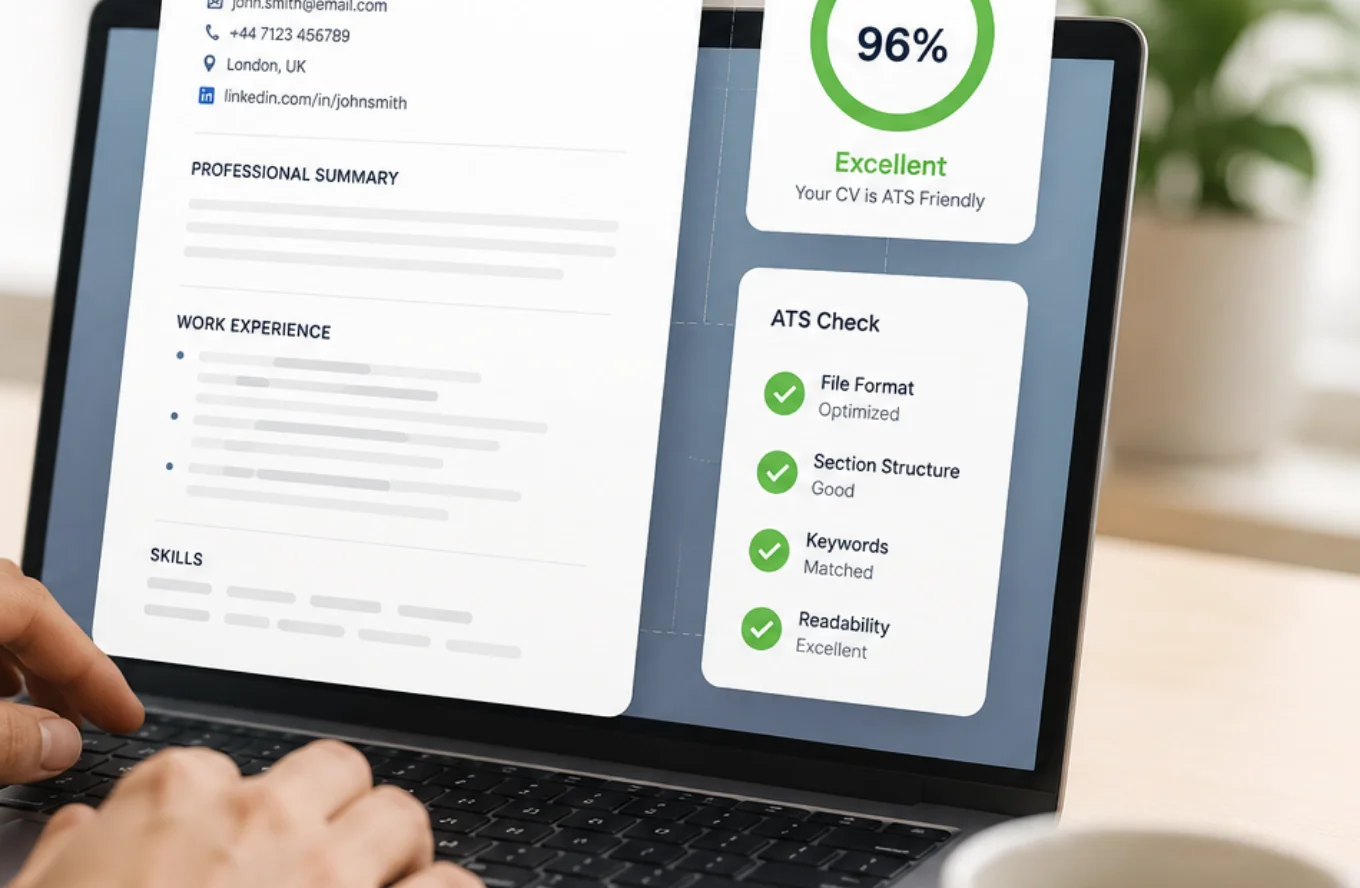
An applicant tracking system, or ATS, is the software most employers use to collect and sort applications. It reads your CV into structured fields before a recruiter opens it. If it cannot read your file cleanly, your experience comes out garbled or missing, and a good candidate gets filtered on formatting alone, before anyone has judged the substance.
Being ATS-safe does not mean a dull CV. It means a structurally clean one. Most parsing failures come from layout tricks that look fine to a person and baffle the software.
- Use a single-column layout with plain section headings such as Experience, Education and Skills. Multi-column and sidebar designs often come out in the wrong order.
- Keep text as text. Anything set in an image, icon or text box is invisible to the parser.
- Avoid tables used for layout, and keep your contact details in the body rather than the header or footer, where some parsers drop them.
- Send the file the advert asks for, usually a .docx or a text-based PDF, never a scan or an export-as-image.
Mirror the job's language, honestly
The software and the person screening your CV want the same thing: evidence you have done what the role needs. When the advert says "stakeholder management" and your CV says "worked with teams across the business", the keyword filter scores you low and the recruiter skimming at speed misses the match. Using the role's own words closes that gap.
Done honestly, this is not keyword stuffing. It is picking, from the true things you have done, the wording that lines up with the advert, and claiming only what you could defend in an interview. Borrow a skill you do not have and it surfaces in the first conversation, taking your credibility with it.
- Pull the skills and phrases that come up more than once in the job description, and use those exact terms wherever they are genuinely true of you.
- Write a term the way a search would look for it: the full phrase and, where it reads naturally, the common abbreviation alongside it.
- Never claim a skill, tool or title you cannot back up. Tailoring is choosing what to foreground, not inventing.
Lead with results, not duties
A duty says what you were responsible for. A result says what changed because you were there. "Responsible for the test strategy" tells a reader your job title. "Rebuilt the test strategy and cut release regressions by a third" tells them what hiring you gets them. People remember outcomes, and outcomes are what separate two candidates with the same CV on paper.
Open each bullet with a strong verb and finish on the effect, ideally one you can measure. Not every achievement comes with a tidy number, and you should never invent one, but most have a direction: faster, cheaper, fewer defects, more reliable, used by more people.
- Start with an action verb: led, rebuilt, shipped, reduced, automated.
- Say what you did, specifically enough that it could only have been you.
- Finish on the outcome, with a real figure where you have one and a clear direction where you do not.
Tailor for each role
One CV sent to forty roles is tuned to none of them. A tailored CV re-orders, rewords and re-weights the experience you actually have to match what this employer asked for: the relevant projects first, the skills they named brought forward, the parts that do not serve this application trimmed back. To the reader it simply looks like a close fit.
People skip tailoring because rewriting from scratch for every role is not sustainable, and they are right. The trick is not to drop tailoring but to make it cheap. Keep one strong base CV and adapt a copy of it per role, rather than starting from a blank page each time.
- Keep a complete base CV as your source of truth, and tailor a fresh copy for each application.
- Re-order the content so the experience that matters most for this role sits highest.
- Rework the summary and skills to suit the advert, and cut the detail that does not earn its place here.
Put it to work
JobFocus turns these into one calm flow: an aggregated UK feed, a CV scored and tailored per role, and an Apply button that opens the job's own page for you to finish. We never auto-submit.